Timeless Serenity: Monochrome Magic at Kenninji Temple
Color can dazzle, but sometimes it distracts. Remove it, and what remains—the lines, the textures, the silence between light and shadow—tells the truer story.
Table of Contents
- The Timeless Beauty of Monochrome
- Nature’s Frame: Trees and Shadows
- Capturing Essence Over Detail
- Applying These Lessons
- Finding Poetry in Everyday Scenes
The Timeless Beauty of Monochrome
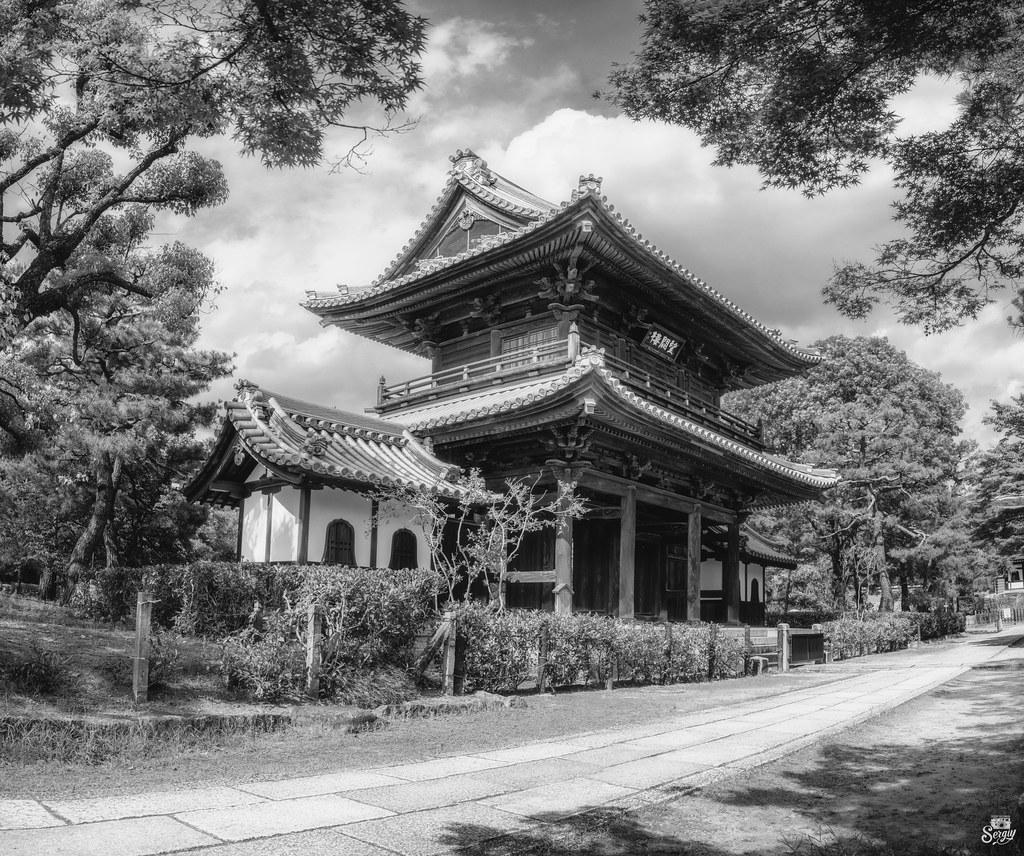
In this photograph of Kyoto’s Kenninji Temple, the absence of color sharpens our awareness. What’s left is structure and stillness—the grain of wood, the quiet geometry of rooflines, the way light gathers in corners. Black-and-white doesn’t romanticize; it distills. It strips away distraction until the image breathes on its own.
There’s something liberating about that restraint. The temple doesn’t need to compete with its surroundings or the viewer’s expectations. It simply exists—anchored in form, unbothered by time.
Nature’s Frame: Trees and Shadows
The composition invites you in without announcing itself. Branches edge into the frame, softening the temple’s precision. The shadows under the eaves are not decoration—they are structure, shaping the space as much as the wood itself. The walkway curves just enough to suggest motion through stillness.
It’s an image that understands balance without symmetry, presence without insistence. Nature and architecture coexist here without needing to prove their harmony.
Capturing Essence Over Detail
Much of modern photography chases sharpness, contrast, spectacle. This one doesn’t. It asks for attention, not applause. Its quietness is deliberate. The absence of drama lets texture and proportion do the talking.
That’s the deeper lesson: to photograph not what something looks like, but what it feels like when you stand before it—the weight of history, the rhythm of light, the silence that outlasts visitors.
Applying These Lessons
If you want your travel photography to carry more weight, start here:
- Simplify: Reduce your palette—visually and emotionally. Decide what belongs in the frame and what doesn’t.
- Let Light Lead: Notice how light defines edges, not how color fills them. Shape your image around tone, not hue.
- Be Patient: Wait for stillness. Let the scene reveal itself instead of forcing a moment into being.
Restraint isn’t about austerity—it’s about clarity. The fewer choices you make, the stronger each one becomes.
Finding Poetry in Everyday Scenes
There’s nothing overtly dramatic about this image. No sweeping sky, no human subject. And that’s why it works. It’s an act of attention—a photograph that rewards looking instead of scanning.
Great travel photography isn’t about chasing the rare. It’s about seeing the familiar without sleepwalking past it. The poetry isn’t in the temple; it’s in the gaze that noticed how the shadows fit the roofline just so.

Kenninji Temple, Kyoto. No color needed—just light, wood, and the patience to notice.
Photo by Sergiy Galyonkin. Licensed under CC BY-SA.