Rain-Soaked Reflections: Cologne Cathedral’s Hidden Stories
In a world saturated with postcard-perfect images of iconic landmarks, it takes a fresh perspective to stop us in our tracks. This photograph does exactly that—inviting us not only to look, but to linger, to find the extraordinary in details we might have otherwise overlooked.
Table of Contents
- A Study in Texture: The Cologne Cathedral
- Capturing Reflections: Rain as an Ally
- Movement and Stillness: A Dance of Contrasts
- What You Can Take Away
- Conclusion: The Art of Seeing
A Study in Texture: The Cologne Cathedral
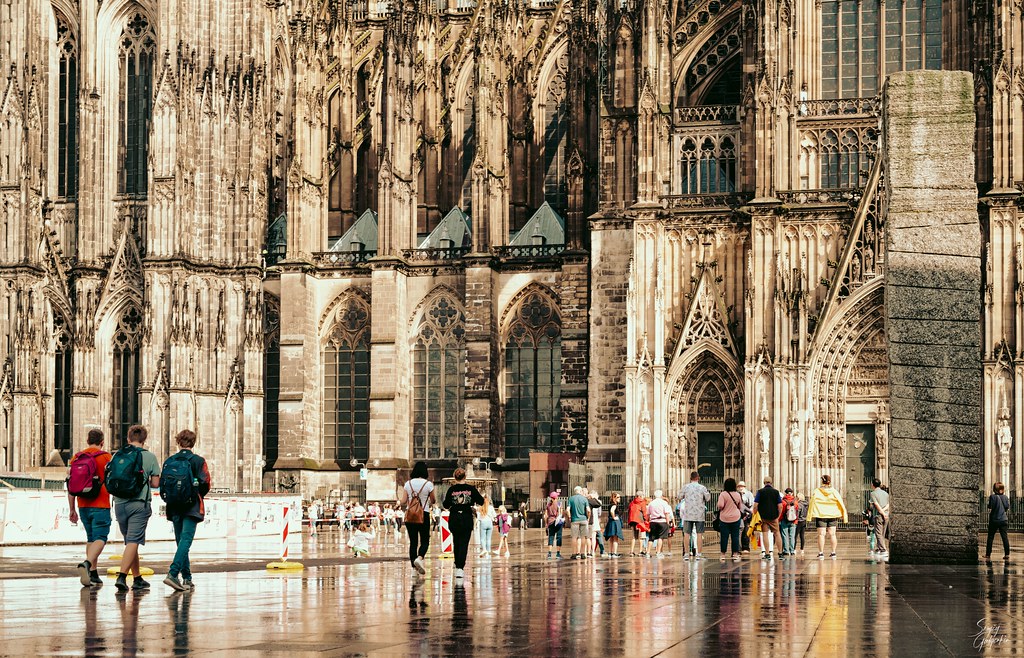
Most photographers approach Cologne Cathedral with the same ambition: to capture its monumental spires in full, broadcasting grandeur from frame to frame. But here, the lens chooses intimacy over scale. The cathedral’s intricate façade becomes not just architecture, but a backdrop for modern life as it unfolds beneath those Gothic arches. The stonework ceases to be mere ornament—it transforms into a stage set for human stories.
By resisting the urge to show everything, the photographer achieves more. This partial perspective creates room for imagination, teasing out a narrative that feels personal rather than monumental. It’s a reminder that sometimes the most powerful image is not of the whole, but of the fragment that invites curiosity.
Capturing Reflections: Rain as an Ally
Rain is often the enemy of travel photography—grey skies, dripping lenses, soggy crowds. Yet here, it becomes a creative partner. The freshly wet pavement reflects both cathedral and passersby, doubling the drama and adding a liquid shimmer to the composition. Suddenly, the ordinary becomes cinematic.
Reflections whisper from another world—ephemeral, transient, and yet deeply evocative. Paired with centuries-old stone, they conjure a dialogue between permanence and impermanence. For photographers, these fleeting mirror-worlds are more than technical tricks; they’re opportunities to layer emotion into the frame.
Movement and Stillness: A Dance of Contrasts
Equally striking is the interplay of motion and immobility. Figures stroll casually across the square, while behind them the cathedral stands resolute, its Gothic lines unchanged by centuries. This juxtaposition—human transience against architectural endurance—breathes vitality into the image. What could have been a static study of stone becomes a meditation on time itself.
The photograph reminds us that history is never frozen; it lives, it breathes, it coexists with our everyday steps. In that moment, we see not just a landmark, but the ongoing dance of permanence and change.
What You Can Take Away
So, the next time you find yourself under rain-soaked skies or before an imposing monument, consider an alternative approach:
- Let Texture Speak: Focus on fragments, let patterns and details carry the story.
- Embrace the Weather: Rain, mist, or puddles can transform mood and expand your visual vocabulary.
- Seek Contrasts: Capture the tension between human movement and architectural stillness.
These choices don’t just produce photographs; they create experiences that invite viewers to linger, wonder, and feel.
Conclusion: The Art of Seeing
Travel photography is never only about where we point the lens. It’s about how we choose to see. This image of Cologne Cathedral proves that even the most photographed monument can surprise us if we approach it differently—through texture, through reflection, through the interplay of movement and stillness.
Grand vistas will always have their place, but true artistry often emerges in the quieter moments: in a puddle’s gleam, in a stone’s curve, in the fleeting shadow of a passerby. These are the details that transform a landmark into a living story—and that is the essence of seeing anew.

Amidst the towering grandeur of Cologne Cathedral, visitors drift like whispers beneath its Gothic arches, their reflections shimmering across rain-slicked stones.
Photo by Sergiy Galyonkin. Licensed under CC BY-SA.