Chania’s Magic: Reflections, Colors, and Captured Moments
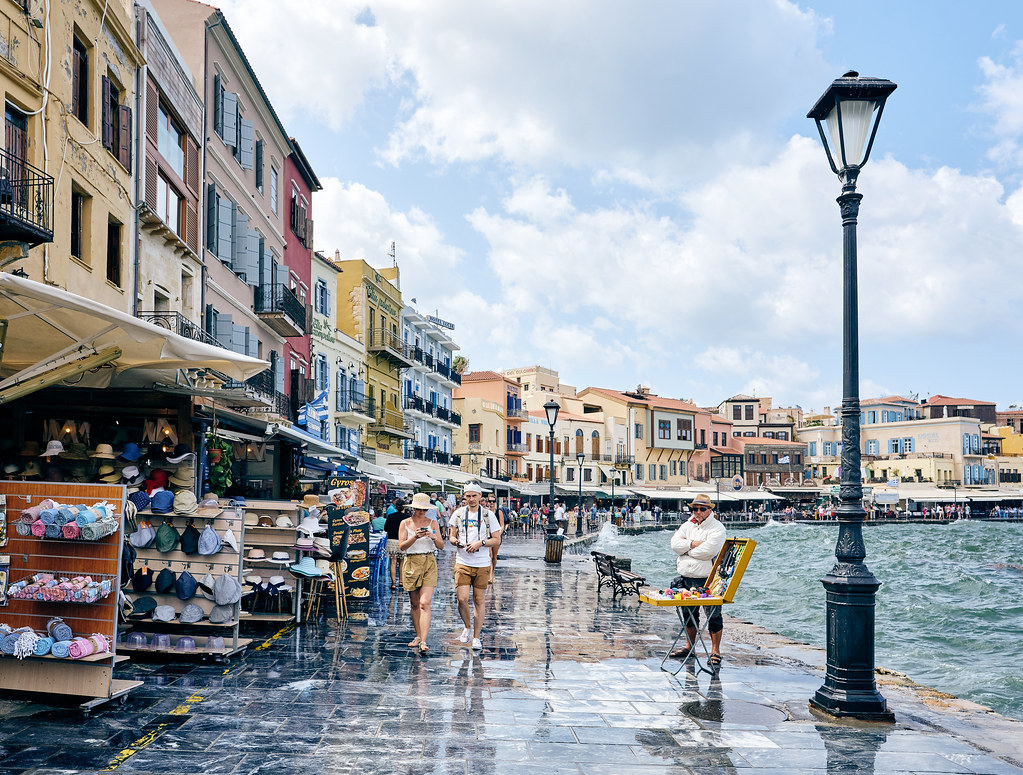
A walk along the lively seaside promenade in Chania, Greece, is more than a leisurely stroll—it’s an invitation to discover the unexpected beauty that makes travel photography unforgettable.
Table of Contents
- The Magic of Reflection
- The Human Element
- Framing with Context
- Practical Tips for Your Travel Photography
- Embrace the Unexpected
The Magic of Reflection
This image captivates because it subverts expectations: the polished walkway reflects like glass, while the water remains curiously matte. Normally, it’s the sea that mirrors the world—but here, the street itself gleams as if it were the true surface of reflection. The inversion draws the eye and challenges the viewer’s sense of what belongs where. For photographers asking “How do I photograph Chania, Greece?” this is the lesson: stay alert for those rare, rule-breaking details that transform an ordinary view into something extraordinary.
The Human Element
The two figures walking along the glistening path provide not just scale but also narrative. Their movement anchors the frame, humanizing a scene that could otherwise feel purely architectural. Including people in your travel photography adds relatability—it pulls viewers into the moment, inviting them to imagine themselves in the scene. Here, the tourists are more than background; they’re the story’s heartbeat.
Framing with Context
Composition gains power from contrast and context. In this frame, colorful Venetian façades stretch in one direction while the restless sea balances the other. The dialogue between built environment and natural force enriches the story without cluttering it. The vertical rhythm of architecture meets the horizontal pull of water, creating harmony through opposition. When exploring Chania—or any destination—slow down and experiment with perspectives until the scene’s elements arrange themselves into a natural conversation within the frame.
Practical Tips for Your Travel Photography
-
Seek Unusual Reflections: Don’t just look to water—glass, stone, even polished wood may surprise you with their reflective magic.
-
Include People: Figures provide scale, relatability, and an anchor of human presence in otherwise grand or chaotic environments.
-
Play With Composition: Test angles, shapes, and lines until the architecture, people, and environment fall into a rhythm that feels inevitable.
Mastering travel photography isn’t about chasing postcard clichés; it’s about training your eye to notice these subtle dialogues between light, reflection, and life. With practice, even the most familiar streetscapes can become compelling narratives.
Embrace the Unexpected
The most enduring travel photographs are often the ones you didn’t plan. A wet walkway shimmering like a mirror, a passerby framed at just the right instant—these fleeting details hold more magic than meticulously staged scenes. In Chania, Greece, the unexpected is everywhere, waiting to reward those who stay receptive. Every corner turned, every glance downward or upward may yield a photograph that tells its own story.
So take your camera, wander without agenda, and let the city surprise you. The images you bring home will carry not just the look of a place, but its living pulse.

Colorful Venetian buildings line the bustling waterfront in Chania, Greece, as tourists and vendors animate the lively promenade under a clear Mediterranean sky.
Photo by Pedro Szekely. Licensed under CC BY-SA.