Red Square Reverie: Light, Shadows, and Timeless Tales
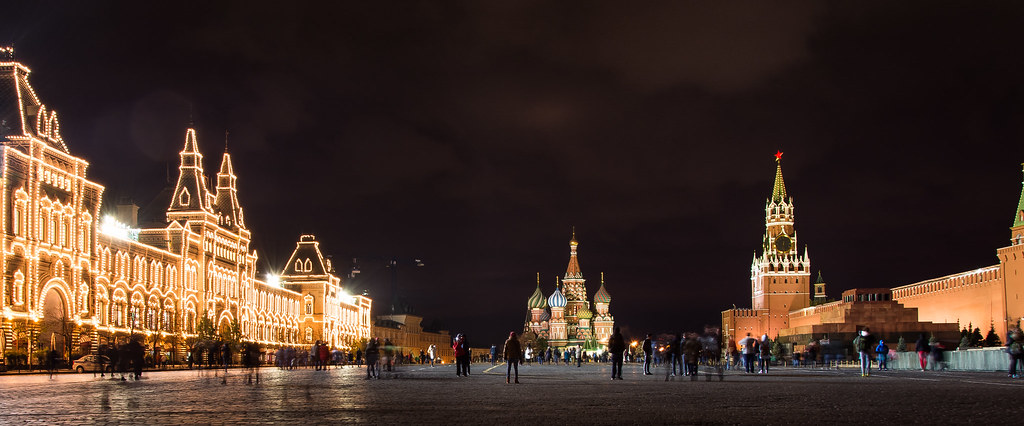
In the heart of Moscow, where the past glows as bright as the present, this photograph captures Red Square at night—an illuminated symphony of light and history. The city’s architecture seems sketched by hand in luminescent gold, like an electric Etch A Sketch drawing brought to life. Every line hums with precision; every glow seems to vibrate with centuries of stories. This is more than a night scene—it’s a meditation on how light, time, and craft converge in one perfect frame.
Table of Contents
- The Artistry in Exposure
- St. Basil’s Cathedral: A Hidden Jewel
- How Light Transforms Space
- Tips for Photographing Red Square
The Artistry in Exposure
Behind this unforgettable photograph lies a lesson in technical details. A 1.3-second exposure, balanced at ISO 160 for great detail with f/10.0 for depth of field, all through a wide 18.0mm lens (27mm equiv.). The scene breathes—long enough to soften motion but short enough to preserve crisp architectural detail. The result is a deliberate tension between motion and stillness. The cobblestones shimmer like liquid glass, while figures passing through the frame blur into ethereal shapes that seem half-ghost, half-memory.
The lighting conditions of Red Square present a formidable challenge. The GUM department store’s incandescent facade produces one of the most complex exposure ranges in Moscow: tens of thousands of pinpoint bulbs outlining every arch and cornice. Without careful metering, highlights can easily blow out, losing definition. The photographer’s choice to slightly underexpose ensures that the cathedral and Kremlin towers maintain texture and depth, letting the lights glow without overpowering the darker sky. This is exposure as orchestration—the balancing of brilliance and restraint.
Every luminous line contributes to the overall composition, sketching geometry against the void of night. It’s this intricate play of light that evokes the Etch A Sketch analogy—an image both spontaneous and controlled, drawn and erased in the same moment by time’s invisible hand.
St. Basil’s Cathedral: A Hidden Jewel
At the center of the image, framed by history’s grand facades, stands St. Basil’s Cathedral—an architectural riddle wrapped in color and legend. Commissioned by Ivan IV, known to history as Ivan the Terrible, the cathedral was completed in 1561 to commemorate his victory over the Khanate of Kazan. Officially named the Cathedral of the Intercession of the Most Holy Theotokos on the Moat, it later became known simply as St. Basil’s after the venerated local holy man buried nearby.
Its nine chapels, each topped with a distinct onion dome, symbolize both unity and diversity—an architectural reflection of medieval Russia’s turbulent consolidation. The polychrome patterns we see today, often mistaken for whimsical ornamentation, were actually added nearly a century after its completion, transforming the cathedral into a kaleidoscope of faith and folklore. Beneath those swirling domes lies a labyrinth of narrow staircases, low arches, and frescoed alcoves—a sacred geometry that feels more like a pilgrimage than a structure.
In this image, the cathedral glows like a secret waiting to be rediscovered. Though flanked by brighter, more commanding lights, it remains the gravitational heart of the square. Its brilliance lies not in dominance, but in quiet persistence—the kind of beauty that endures through centuries, through revolutions, through changing lenses and shifting light.
How Light Transforms Space
Lighting here is both architecture and atmosphere. The left flank of the composition—GUM’s outline traced in white bulbs—creates a rhythmic frame that draws the eye toward the cathedral. Each bulb becomes a note in a larger score, playing against the darker harmonies of the Kremlin walls to the right. The overall color temperature sits around 2700K, giving the scene its warm amber glow against the cool, nearly blue night sky. The photographer’s white balance keeps the tones natural without sacrificing contrast, allowing the light to sculpt rather than wash.
Long-exposure night photography in such environments demands stability and anticipation. Even the faintest vibration can distort the fine outlines of the buildings. A sturdy tripod, remote shutter release, and mirror lockup (or electronic shutter) are crucial to avoid micro-shake. Shooting RAW format allows for gentle post-processing—subtle recovery of shadows, reduction of orange cast from tungsten bulbs, and retention of authentic sky texture.
But beyond the technique, there’s poetry in this illumination. The lights don’t simply reveal form—they narrate it. They turn centuries of Russian architecture into a living storyboard of energy, faith, and endurance. Each tower and wall becomes both subject and storyteller, glowing with the accumulated weight of history.
Tips for Photographing Red Square
Timing: The blue hour, just after sunset or before dawn, offers the richest color interplay between sky and artificial lighting. At this time, the deep indigo overhead softens the scene, allowing the warm tones of GUM and the cathedral to bloom without oversaturation.
Settings: Start at ISO 100 to minimize noise, aperture around f/8–f/11 for optimal sharpness and depth, and shutter speeds between one and two seconds to introduce the right level of motion blur. Bracket exposures if necessary, especially to preserve highlight detail on GUM’s bright lights and shadow detail on the cathedral’s darker recesses.
Composition: Use the cobblestones’ linear patterns as natural leading lines—they converge subtly toward St. Basil’s, guiding the viewer’s gaze. Maintain symmetry but embrace asymmetry in human presence: a few blurred figures keep the image alive and human without cluttering it.
Perspective: A wide-angle lens (around 24mm full-frame equivalent) captures the full breadth of the square while preserving depth. For tighter studies of architectural texture, a 50mm lens can highlight intricate brickwork and bulb contours without distortion.
Ultimately, photographing Red Square isn’t just about mastering light—it’s about listening to it. This image, with its golden tracery and ghostly silhouettes, teaches patience, timing, and reverence. It reminds us that the best photographs are not taken; they’re revealed—etched moment by moment, like lines of light on the world’s most radiant Etch A Sketch.

Illuminated against the night sky, Red Square in Moscow becomes a realm of glowing architecture and timeless shadows, where history whispers amidst the footsteps of wanderers. Photo by Michael Kuhn. Licensed under CC BY.