Capturing Majesty: Simplicity in Castle Photography
A great photograph can whisper or it can roar. Sometimes, its quietest moments—the clean lines, the uncluttered frame—speak loudest of all. Simplicity, when done well, is the art of restraint that lets beauty breathe.
Table of Contents
- Simplicity at Its Finest
- Mastering Exposure
- Perfect Angle and Composition
- Capturing Foreground Details
- Framing with Foreground Elements
- Takeaways for Aspiring Photographers
Simplicity at Its Finest
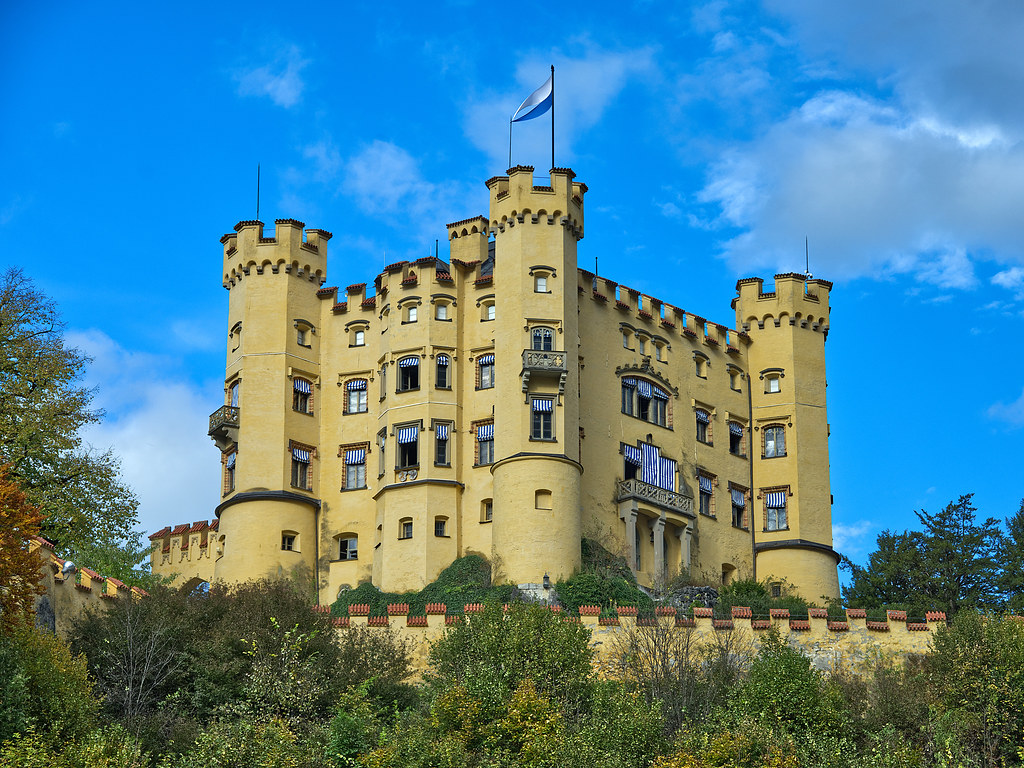
The photograph of Hohenschwangau Castle captures a masterclass in simplicity. There are no gimmicks, no distractions—just balance, light, and form in perfect harmony. It’s a reminder that the most striking images often emerge when we remove everything that isn’t essential.
Mastering Exposure
Exposure is the soul of any photograph. In this image, the photographer has tamed Bavaria’s bright alpine light, balancing luminous skies with the castle’s warm ochre tones. Neither the highlights nor the shadows dominate; both coexist in elegant equilibrium. This control over exposure transforms an ordinary daytime scene into something timeless—proof that attention to light can elevate even familiar subjects into art.
Perfect Angle and Composition
The castle rises with quiet authority, shot from just below eye level to lend a sense of grandeur without distortion. The composition draws the viewer upward, from the soft greenery in the foreground to the crenellated towers against the blue sky. It’s a study in proportion and restraint—every line leading somewhere, every element contributing purposefully to the whole.
When photographing landmarks like Hohenschwangau Castle in Schwangau, Germany, remember: the goal isn’t simply to record, but to reveal. Seek an angle that tells a story—one that honors both the structure and the space around it.
Capturing Foreground Details
Foregrounds are the unsung heroes of landscape photography. Here, a veil of foliage softens the composition, drawing the eye through the frame rather than stopping it at the castle walls. Those small, organic details—leaves, branches, grass—anchor the image in reality, giving it texture and depth. Without them, the photo might feel sterile or distant.
The juxtaposition between natural elements and man-made structure gives the image tension and vitality. It reminds us that photography thrives on contrast: curve against line, light against shadow, nature against architecture.
Framing with Foreground Elements
Framing isn’t just about inclusion—it’s about intention. The trees surrounding Hohenschwangau act as a natural vignette, guiding the viewer’s gaze inward while adding a sense of discovery. The frame within the frame invites us to peer through, as if glimpsing a secret world revealed only to the patient observer.
Takeaways for Aspiring Photographers
From this serene composition, there are lessons worth carrying into your next shoot:
- Expose with care — Control your light to preserve the story in both highlights and shadows.
- Experiment with perspective — A few steps higher or lower can transform the entire emotional register of an image.
- Frame with purpose — Use surrounding elements to add depth, not distraction.
- Embrace simplicity — Let your subject breathe; silence can be the most powerful form of expression.
Photography is less about what you include and more about what you choose to leave out. When done with intention, simplicity doesn’t diminish—it amplifies.

The sunlit Hohenschwangau Castle stands majestically against a vibrant blue sky, its crenellated towers and golden facade evoking tales of Bavarian royalty.
Photo by Geoff Henson. Licensed under CC BY-ND.