Covehithe’s Ancient Ruins in Infrared: A Dreamscape Unveiled
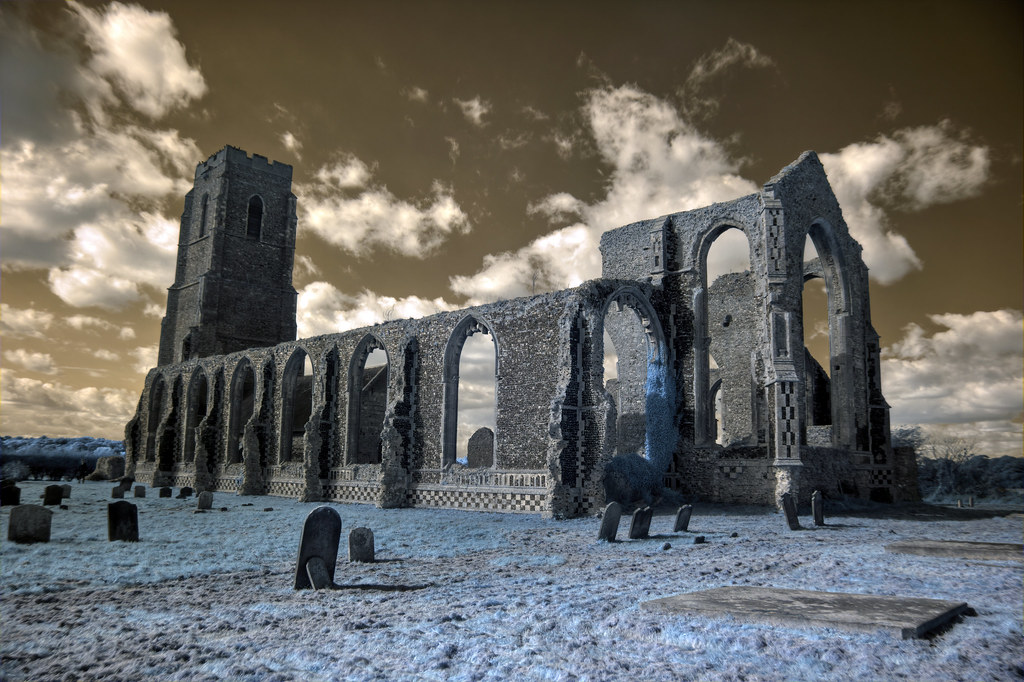
The ruins rise like ancient sentinels, silhouetted against a sky awash in ethereal hues. It’s a scene that feels both timeless and otherworldly, and it’s no wonder the image holds us so completely.
Table of Contents
- The Allure of Infrared Photography
- Capturing Timelessness
- Lessons for Your Travel Photography
- Tips for Shooting Infrared
- The Emotional Impact
- Final Thoughts
The Allure of Infrared Photography
Infrared photography opens a hidden dimension of the world, capturing light invisible to the human eye. Familiar landscapes become dreamscapes, bathed in tones that defy expectation. In this image of St. Andrew’s Church in Covehithe, England, infrared transforms the scene: skies glow in warm, spectral shades while the stones and earth cool into deep blues. The result is a surreal vision that both unsettles and enchants.
Capturing Timelessness
The weathered stones of St. Andrew’s Church speak of centuries endured, their silence etched with memory. Infrared emphasizes these contrasts—light versus shadow, permanence versus decay—bringing textures into sharp relief. The technique heightens the drama, allowing the viewer to sense not only the physical ruin but the passage of time itself.
For those wondering how best to photograph ruins like St. Andrew’s Church in Covehithe, infrared offers an avenue beyond the literal, revealing dimensions often hidden to the naked eye.
Lessons for Your Travel Photography
Travel photography is more than documentation—it is interpretation. Infrared adds nuance and emotional weight to your work by:
- Exploring New Perspectives: Infrared challenges the ordinary, encouraging fresh creative choices.
- Enhancing Textures: Surfaces—whether stone or foliage—become more vivid, almost tactile in their detail.
- Creating Mood: Subtle shifts in tone and contrast let you lean into either mystery or serenity, depending on your vision.
The best images capture not only what was seen but what was felt—the essence beneath appearances.
Tips for Shooting Infrared
If you’re inspired to explore infrared after encountering this haunting image, consider:
- Gear Choices: Dedicated infrared conversions deliver the richest results, but an IR filter on a standard lens can also produce striking effects.
- Light Conditions: Midday sun emphasizes bold contrasts, while softer light creates subtler, more atmospheric tones.
- Creative Experimentation: Allow for surprise. The unexpected often yields the most compelling results.
Infrared rewards curiosity. Whether capturing ruins, woodlands, or even city streets, let instinct and experimentation guide your lens.
The Emotional Impact
This photograph is less about documentation than evocation. Its spectral palette and dramatic interplay of light and shadow summon reflection—on time, on transience, on the quiet persistence of nature. The image functions as a visual poem, engaging not just the eye but the imagination.
For those seeking resonance in their own work, infrared is not just a tool but an artistic language—one that bridges the seen and the unseen.
Final Thoughts
In rendering St. Andrew’s Church through this spectral lens, the photograph reminds us that beauty often lies in the overlooked and the unconventional. Travel photography thrives when it pushes boundaries, when it uncovers what lingers beneath the surface. Infrared, in its ability to unveil hidden worlds, serves as a reminder that every place carries more than meets the eye.
Let every shutter click be an act of discovery—not only of landscapes and ruins, but of emotions and stories waiting to be told.

The haunting silhouette of St. Andrew’s Church in Covehithe stands against a surreal sky, whispering tales of time and decay amidst forgotten gravestones.
Photo by David. Licensed under CC BY.