Landmarks and Signs in Travel Photography: A Stunning Example from the Rijksmusuem in Amsterdam
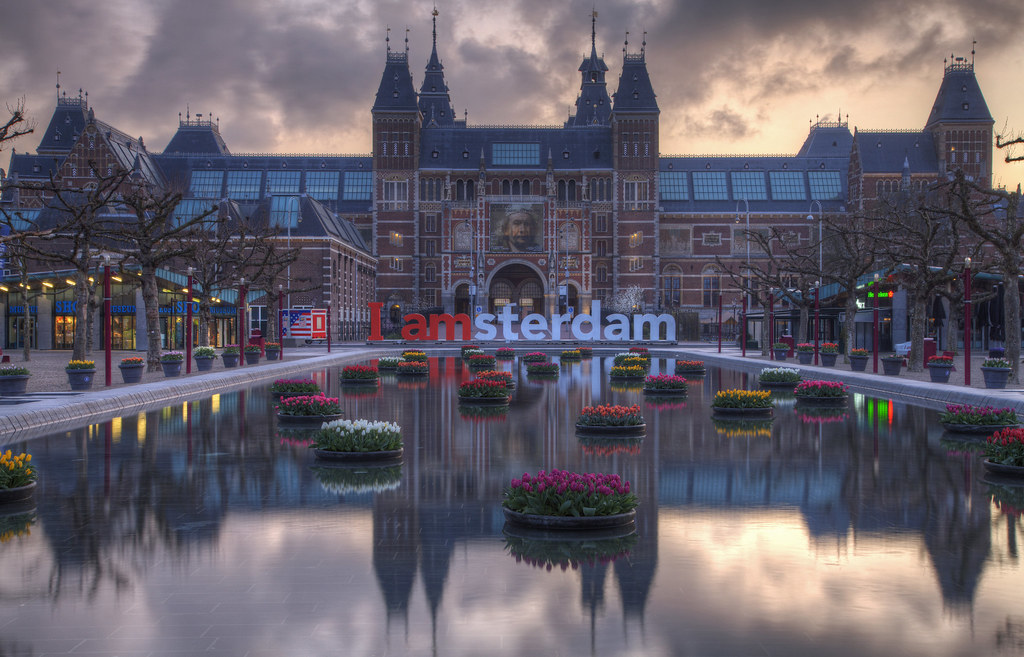
Place signs like the famous “I amsterdam” are everywhere, but in this image, the photographer transforms it into a seamless element of the scene. Framed perfectly against the Rijksmuseum, the sign feels almost like an overlaid caption rather than a physical object—an optical trick that blends text and place into a single visual statement.
Table of Contents
- Using Signs Creatively
- The Charm of Reflections
- How Composition Elevates Travel Photography
- How to Photograph Rijksmuseum in Amsterdam
- Mastering Light and Mood
- Capturing the Essence of Place
- Conclusion: Transforming the Ordinary into Extraordinary
Using Signs Creatively
Signs are often treated as something to avoid in a photo, but they can be a powerful storytelling tool. Here, the “I amsterdam” sign becomes more than a tourist prop—it’s an integral part of the frame, echoing the city’s personality while interacting with its surroundings. The key is placement: the photographer aligned it so that it works in harmony with the architecture and reflections rather than competing for attention.
- Think Integration, Not Inclusion: Instead of photographing a sign directly, position yourself so it blends naturally into the scene.
- Use Perspective: Shift your angle so that the sign’s letters interact with architectural or natural elements.
- Play With Depth: Layer the sign between foreground and background subjects for added dimensionality.
The Charm of Reflections
The water in front of the Rijksmuseum serves as a perfect mirror, doubling the impact of both the building and the “I amsterdam” sign. This symmetry not only adds depth but also creates an almost surreal effect, making the sign appear weightless.
Tips for Capturing Reflections
- Timing: Golden or blue hour for softer light and stronger colors.
- Angle: Get low to maximize the reflection surface.
- Stability: Use a tripod to preserve sharpness, especially in low light.
How Composition Elevates Travel Photography
From the floating tulip beds in the foreground to the ornate towers in the background, this composition leads the viewer’s eye along a deliberate path. The centered symmetry anchors the scene, while the color pops in the flowers and sign add focal points of interest.
- Rule of Thirds: Useful for asymmetrical compositions, but break it for symmetry when it works.
- Leading Lines: Use pathways, water edges, or architecture to guide the gaze.
- Framing: Incorporate natural frames—trees, archways, or doorways.
How to Photograph Rijksmuseum in Amsterdam
While the Rijksmuseum is photogenic from many angles, shooting from the reflection pool at dawn gives you both tranquility and perfect symmetry. Arrive early to avoid crowds around the sign.
- Lens: Wide-angle (16–35mm) for context.
- Aperture: f/8–f/11 for depth.
- ISO: Low (100–200) for crisp quality.
- Shutter: Longer exposures enhance water smoothness and reflections.
Mastering Light and Mood
Twilight light gives the brickwork a warm glow while softening shadows, balancing the cool tones in the sky. This mood fits perfectly with the calm water reflection, adding a painterly quality to the shot.
Capturing the Essence of Place
In one frame, this photo blends Amsterdam’s identity—art, architecture, and flowers—with a clever use of its most famous sign. That’s travel photography at its best: a single image that encapsulates a city’s character.
Conclusion: Transforming the Ordinary into Extraordinary
Next time you’re photographing a landmark with a famous sign, think beyond the snapshot. Integrate it into the environment. Use light, reflections, and composition to make it feel like a natural part of the scene. In doing so, you can turn a cliché subject into an unforgettable image.

The iconic Rijksmuseum in Amsterdam is beautifully reflected in the calm waters, framed by vibrant tulip arrangements and the famous “I amsterdam” sign at dawn. Photo by Ryan Beck. Licensed under CC BY-ND.